
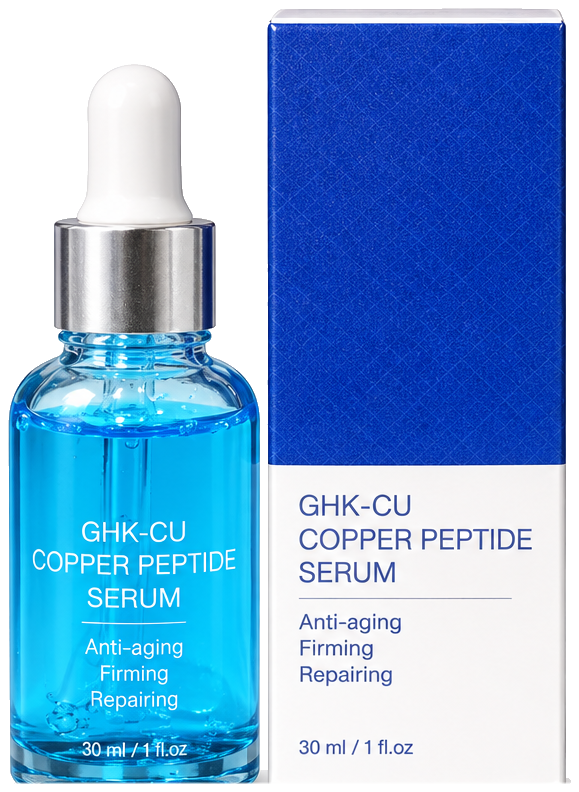
GHK-Cu copper peptide serum is increasingly requested by skincare brands that want a premium, science-led firming and recovery concept. This guide separates established biochemical research from marketing overstatement, explains who may prefer this ingredient, and outlines how a private-label project can be developed from 100 bottles.
What is GHK-Cu?
GHK is a naturally occurring tripeptide that can bind copper ions to form GHK-Cu. In cosmetic development it is commonly discussed in connection with skin-conditioning, barrier-support and appearance-focused firming products. It is not a medical treatment, and finished-product performance depends on the complete formula, concentration, stability, packaging and how the product is used.
What does the research actually show?
Preclinical research has reported that GHK-Cu can influence extracellular-matrix components and wound-related processes. A classic animal study found effects on collagen and glycosaminoglycan accumulation in rat wounds, which is useful mechanistic evidence but is not the same as proof of anti-aging performance in a retail facial serum.
Human cosmetic evidence is more limited. In a small post-laser topical study, objective measures did not show significant differences in erythema or wrinkles, although participants reported a subjective improvement in overall skin quality. A recent review also concluded that more rigorous clinical and skin-permeability studies are needed before strong anti-wrinkle claims can be made. For responsible brand communication, phrases such as “helps support firmer-looking skin” or “skin-conditioning copper peptide serum” are safer than medical or regenerative claims.
Who may be interested in a copper peptide serum?
- Customers concerned with the appearance of early fine lines or reduced firmness.
- Mature-skin routines that need a lightweight, hydrating serum layer.
- Dry or environmentally stressed skin seeking a barrier-support positioning.
- Professional skincare brands building a post-treatment home-care range, subject to local claims rules and practitioner guidance.
- Consumers who prefer peptide-led formulas rather than exfoliating-acid products.
Sensitive-skin users should patch test. Avoid implying that the cosmetic treats wounds, scars or disease. Compatibility with strong acids, oxidizing ingredients and other actives should be assessed in the final formulation rather than assumed from the hero ingredient alone.
Private-label customization rules
Justech supports a low-MOQ development pathway from 100 bottles. A typical project may include formula direction, bottle and dropper selection, color and texture choices, carton artwork and label development. The USD 99 sample-development and logistics program is used to align the sample, packaging and shipment before production planning.
- Define the market and claim scope. Tell us the destination country, sales channel and desired positioning.
- Select a formula direction. Options may include a simple hydrating peptide serum or a broader firming concept with compatible humectants and barrier-support ingredients.
- Review packaging compatibility. Light, oxygen and metal-ion interactions must be considered; the final bottle is confirmed against the formula.
- Approve the sample. Color, odor, skin feel and packaging are reviewed before the production batch.
- Confirm documents and artwork. INCI, batch and export documentation depend on the approved formula and destination-market requirements.
How to build a stronger product page
A useful copper peptide product page should state the cosmetic benefit clearly, list the complete INCI, explain how to use the serum, include a patch-test note and avoid unsupported clinical promises. Show the bottle size, texture, packaging options, MOQ and lead-time assumptions. This creates more qualified B2B inquiries and fewer misunderstandings during sampling.
Start a GHK-Cu private-label project
View the GHK-Cu Copper Peptide Serum, compare the full professional serum range, or use our private-label serum studio to preview a label concept. For formula, packaging and documentation questions, contact our team.
Research references
- GHK-Cu and extracellular-matrix accumulation in an animal wound model.
- Topical copper peptide study after laser resurfacing.
- Recent review of evidence and research limitations.
FAQ
Can GHK-Cu serum be customized from 100 bottles?
Yes. The practical minimum starts from 100 bottles, subject to the chosen formula, packaging and artwork.
Can a brand claim that GHK-Cu heals skin?
Cosmetic claims should focus on appearance and skin conditioning. Medical, wound-healing or disease-treatment claims require a different regulatory pathway and evidence package.
What must be approved before production?
The sample, final INCI, bottle compatibility, artwork, carton specifications and destination-market documentation should be confirmed before the production batch.