
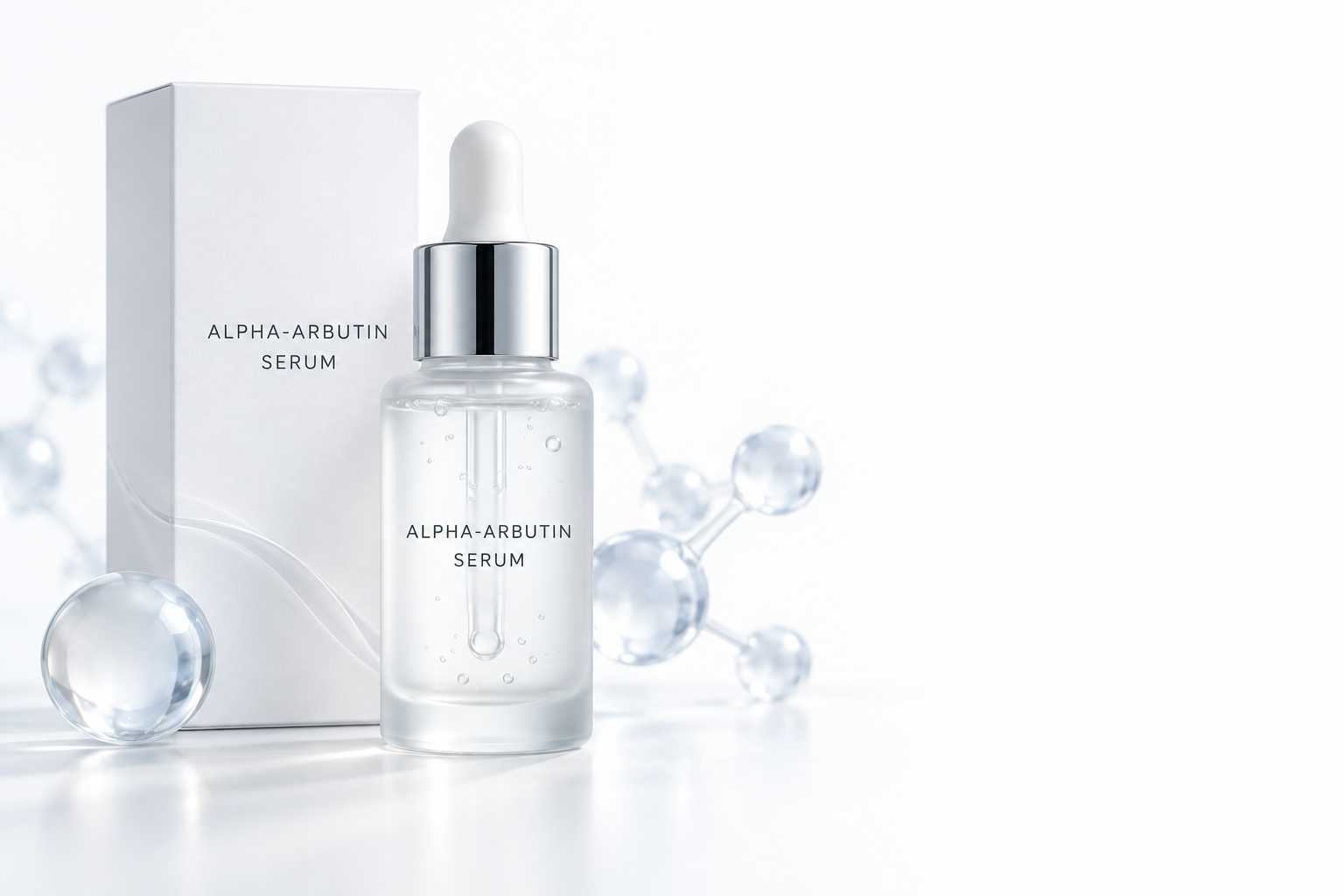
Alpha-arbutin serum is a popular brightening concept for brands targeting uneven-looking tone and the appearance of dark spots. Its cosmetic story is linked to tyrosinase and melanin pathways, but responsible product development requires careful wording, stability work and finished-formula testing.
What is alpha-arbutin?
Arbutin is a glycosylated hydroquinone derivative found in certain plants and also manufactured for cosmetic use. Alpha-arbutin is commonly selected for tone-evening formulas because it can interact with tyrosinase, an enzyme involved in melanin production. This mechanism supports a brightening positioning, but the final cosmetic result depends on concentration, pH, solvent system, packaging, sun-protection habits and consistent use.
What does the evidence say?
A detailed scientific review describes arbutin’s tyrosinase-related mechanism and summarizes laboratory and clinical research, while also noting limitations in the clinical evidence and important stability and safety considerations. A recent small pilot study evaluated a formula containing 5% alpha-arbutin plus 2% kojic acid against triple-combination cream in 30 people with melasma. It provides useful early clinical information for that combination, not proof that every alpha-arbutin serum will perform identically.
Reviews of post-inflammatory hyperpigmentation also emphasize that evidence can be limited for darker skin types and that treatment choices must account for irritation, sun exposure and the cause of pigmentation. For a cosmetic brand, defensible language includes “helps improve the appearance of uneven tone” and “brightening serum for a more even-looking complexion,” rather than promising to cure melasma or permanently remove pigmentation.
Who may benefit from an alpha-arbutin concept?
- Customers concerned about uneven-looking tone or visible dark spots.
- Skin showing the appearance of post-blemish marks after the active irritation has settled.
- Dull-looking skin that needs a gentle brightening routine.
- Consumers who want a non-exfoliating tone-care step.
- Brands serving multiple skin tones and seeking a carefully worded brightening product.
Users should patch test and stop if irritation occurs. Daily broad-spectrum sun protection is an essential part of any tone-care routine. Persistent, changing or medically concerning pigmentation should be assessed by a qualified healthcare professional.
Private-label customization rules
Justech offers private-label serum development from 100 bottles. The USD 99 sample-development and logistics program helps buyers compare formula direction, bottle, carton and artwork before confirming production.
- Choose the positioning. Decide whether the product is a simple alpha-arbutin serum or a broader tone-care concept with compatible hydrating and antioxidant ingredients.
- Confirm the formula range. Concentration and combinations must be reviewed for safety, stability, market limits and claim support; they are not selected by marketing preference alone.
- Control pH and stability. Arbutin chemistry, discoloration risk and storage conditions must be assessed in the finished formula.
- Select protective packaging. Bottle color, closure and light exposure are matched to the approved formulation.
- Approve label and carton. Ingredient list, directions, warnings, batch information and market-specific text are finalized before printing.
- Approve the physical sample. Texture, odor, color, application and packaging fit are checked before mass production.
How to write a compliant product page
Explain the target cosmetic concern, use “appearance” language, publish the full INCI, provide patch-test and sun-protection guidance, and avoid medical before-and-after promises. Include bottle size, MOQ, packaging options and how the buyer can request the required documents. This helps search engines understand the page while giving B2B customers practical purchase information.
Build an alpha-arbutin private-label serum
Compare the professional serum range, test a packaging direction in our private-label serum studio, and contact the Justech team with your destination market, target bottle size and positioning.
Research references
- Scientific review of arbutin mechanisms, evidence, stability and safety.
- Pilot clinical study of alpha-arbutin and kojic acid combination.
- Review of post-inflammatory hyperpigmentation in skin of color.
FAQ
Is alpha-arbutin the same as hydroquinone?
No. They are chemically related, but they are distinct ingredients with different cosmetic and regulatory considerations.
Can alpha-arbutin serum be customized from 100 bottles?
Yes. Formula and package feasibility are confirmed during sampling, with a starting MOQ of 100 bottles.
Should a brightening serum include sunscreen?
A serum does not replace daily broad-spectrum sun protection. Sun-exposure guidance should be included in consumer education for uneven-tone routines.