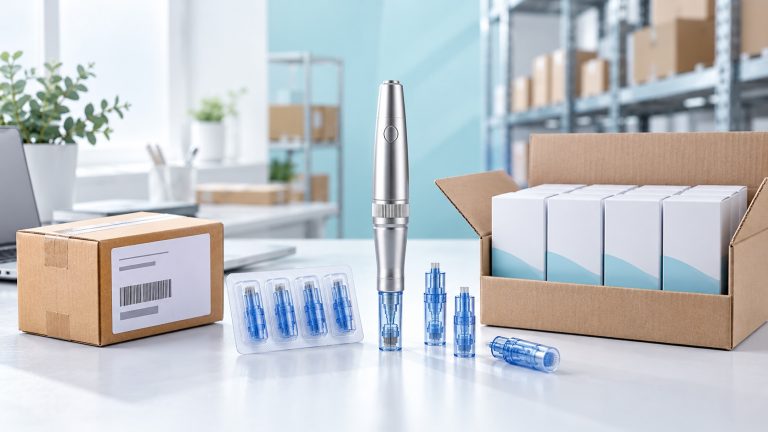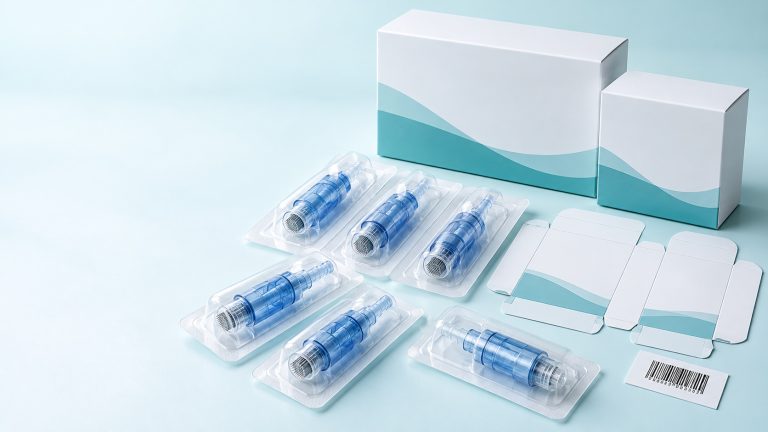

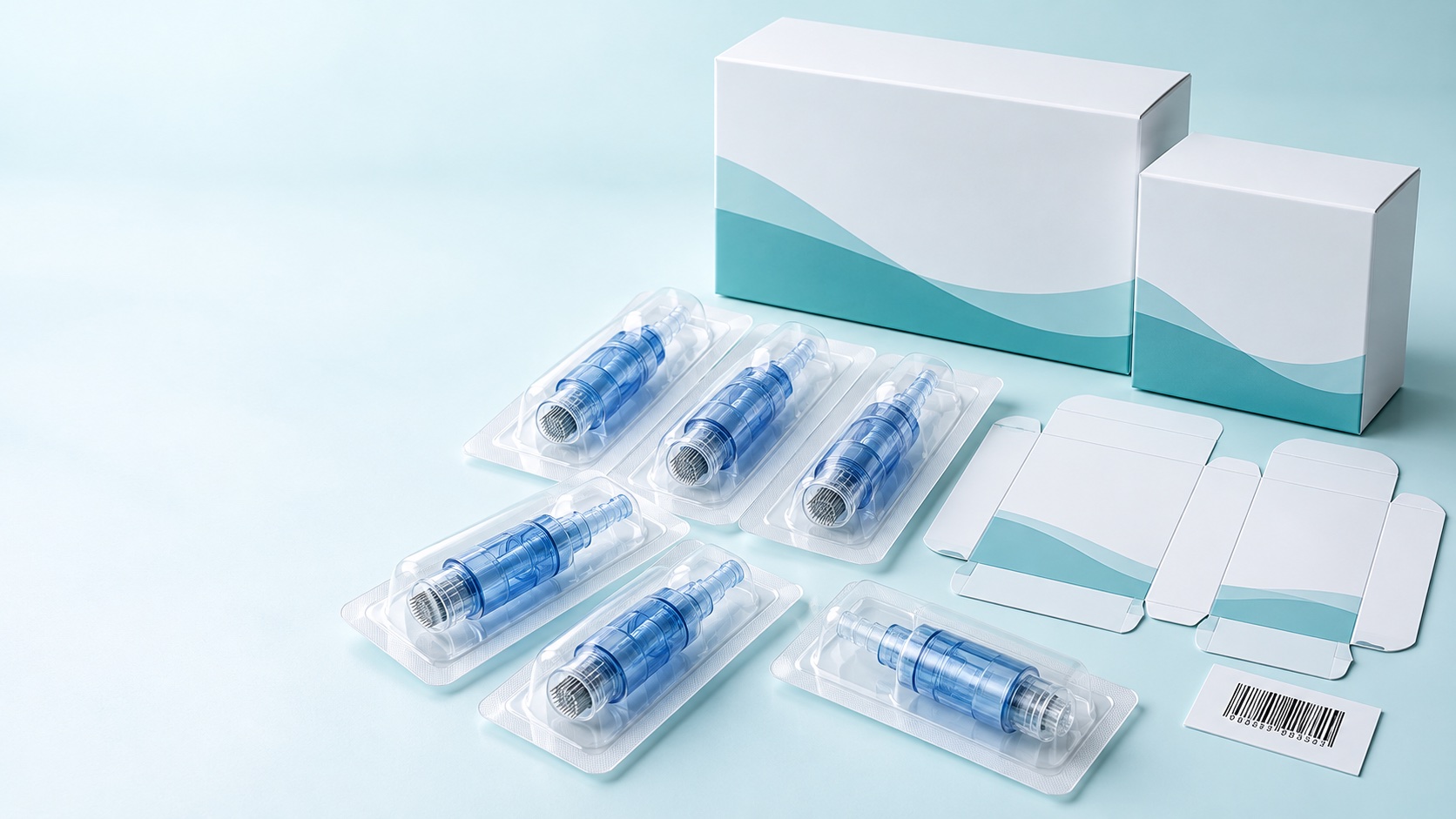
Private label microneedling cartridges can create a valuable repeat-purchase product for beauty brands, clinics, training schools and distributors. But a cartridge project is more technical than printing a logo on a standard box. The connector must match the intended device, the pin configuration must be defined, the individual pack must remain appropriate for the product, and the label must reflect the exact item being supplied.
This guide explains how to prepare a private label microneedling cartridge project without confusing packaging customization with product verification. It is written for professional buyers comparing OEM or branded cartridge supply. It is not medical or regulatory advice, and buyers remain responsible for checking the requirements of the destination market.
What does “private label microneedling cartridges” mean?
Private label can describe several levels of customization:
- Standard cartridge with branded outer packaging. The cartridge specification stays unchanged while the box, label or insert uses the buyer’s brand.
- Branded individual packaging. The buyer requests approved brand elements or market information on each sealed pack, subject to technical and production feasibility.
- Device-and-cartridge bundle. A branded microneedling pen is packaged with a defined cartridge mix for a clinic, training or retail kit.
- Deeper OEM development. The project may involve a different connector, pin configuration, packaging structure or other technical requirements. This normally needs more engineering review, samples and validation than a standard private-label order.
These options should not be quoted as if they have the same MOQ, cost or lead time. The supplier first needs the target device, connector, pin count, quantity and destination market.
Start with device compatibility—not the logo
Cartridges that look similar may not use the same connector. Before discussing artwork, send the supplier:
- the full device name and model;
- clear photographs of the handpiece and original cartridge;
- the connector or locking style;
- requested pin counts or nano configurations;
- the number of cartridges per retail box;
- expected opening order and monthly reorder volume.
The supplier should return a written model-to-cartridge confirmation. For a new project, order representative samples and test physical fit before approving printed packaging. A logo cannot correct an incompatible connector.
Buyers comparing standard supply can review Justech’s Dr.Pen replacement cartridges wholesale page before defining an OEM brief.
Define the exact cartridge specification
An OEM inquiry should identify more than a general description such as “36-pin needle.” A useful specification sheet includes:
- compatible device family;
- cartridge connector and housing reference;
- pin or nano type;
- needle material where documented;
- units per individual pack and outer box;
- package language;
- lot, manufacture or expiry fields where applicable;
- storage and handling information supplied for the exact product;
- barcode or stock-keeping-unit requirements;
- intended sales channel and destination country.
Do not assume that a document for one cartridge family automatically covers another model, connector, pin count or production batch. The final quotation and order approval should identify the exact SKU.
Plan individual packaging and outer boxes separately
Cartridge packaging has at least two different design layers.
Individual pack
The individual pack protects one cartridge and carries information connected to that item. Any change must be reviewed against the current product and available production process. Buyers should confirm what can be printed, which fields remain variable and whether the selected design affects production time.
Retail or wholesale box
The outer box can carry the brand system, product name, compatible model, quantity, barcode and channel information. It can also make inventory control easier by separating similar-looking cartridge families.
Before artwork approval, request the correct dieline and printable area. The buyer should provide editable vector artwork where possible, approved translations and final barcode data. If the seller will offer several connectors or pin counts, use a clear SKU structure rather than one generic box for every cartridge.
Ask for documents tied to the quoted SKU
Professional buyers often ask for “all certificates” before defining the product. That reverses the correct order. First identify the exact cartridge and packaging configuration; then ask what current documents apply to it.
A practical document review may include:
- manufacturer identity;
- product or model scope printed in the document;
- batch or lot information available on the package;
- sterilization information available for the quoted SKU;
- packaging and label references;
- quality-issue and return procedure;
- commercial invoice and packing information;
- destination-market files requested by the importer or marketplace.
The U.S. FDA’s consumer information states that microneedling cartridges should not be reused or used on more than one patient. Buyers should follow the product instructions and local professional-use rules, and should never convert a general certificate or marketing badge into a claim that every model is cleared in every country.
Source: FDA information on microneedling devices.
What determines OEM MOQ?
There is no single responsible MOQ for every private-label cartridge project. The quantity depends on:
- whether the cartridge itself changes or only the outer box changes;
- the connector and pin configurations included;
- the number of languages and package versions;
- the printing process and packaging structure;
- whether the order contains one SKU or several;
- sample and artwork approval requirements;
- destination-market labeling and documentation;
- whether cartridges ship alone or with microneedling pens.
A low opening quantity may be possible for a standard product with limited packaging changes. A deeper OEM project usually requires a larger commitment because materials, printing and production must be prepared specifically for the buyer.
Justech does not publish one universal OEM MOQ for every cartridge. Buyers can submit an OEM project brief and receive feasibility, sample, quantity and lead-time guidance for the exact configuration.
Use samples to test the complete pack-out
The sample stage should answer five questions:
- Does the cartridge physically fit and lock onto the intended device?
- Does the individual pack match the approved structure and information?
- Is the pin count or nano configuration correctly identified?
- Does the outer box hold the agreed quantity without movement or damage?
- Can the buyer distinguish each SKU quickly during receiving and inventory checks?
Keep the approved sample, artwork PDF, product photos and written specification as the control reference for production. If any component changes, request approval before mass production.
Build a repeat-order plan before the first production run
Private label cartridges are normally a replenishment product. The brand therefore needs a reorder system before launch.
Estimate demand using:
- number of devices already sold or installed;
- expected treatments or training sessions per month;
- cartridges supplied with each device kit;
- average monthly retail or wholesale sales;
- supplier production and shipping lead time;
- a safety-stock allowance for delays or demand spikes.
Avoid spreading the opening order across too many slow-moving pin counts. A focused group of compatible SKUs is easier to explain, stock and reorder. Add new configurations after real sales data appears.
Compare quotations on total project cost
The lowest cartridge unit price may not be the lowest launch cost. Compare:
- cartridge price by exact SKU;
- artwork and printing setup;
- samples and revisions;
- individual and outer packaging;
- carton quantity and dimensions;
- inspection or document costs, if any;
- freight, duty, tax and destination charges;
- replacement or quality-issue procedure;
- cost and lead time of repeat orders.
Ask the supplier to separate one-time setup cost from repeat unit cost. This makes it easier to calculate margin after the first production run.
Private-label cartridge red flags
Pause the project if a supplier:
- treats visually similar connectors as universal;
- quotes custom packaging without asking for device model or pin count;
- refuses to provide samples before a large order;
- cannot explain which documents apply to the selected SKU;
- changes the cartridge specification after artwork approval;
- prints regulatory or performance claims without asking for supporting information;
- gives one lead time for every level of customization;
- has no written process for quality issues or incorrect items.
OEM inquiry checklist
Send the following information in one message:
- destination country and sales channel;
- company or brand name;
- device model and cartridge connector;
- requested pin counts or nano types;
- units per pack and number of SKUs;
- first-order quantity and estimated monthly reorder;
- logo, label language and barcode requirements;
- whether you need standard supply, outer-box private label or deeper OEM work;
- desired launch date;
- documents your importer, marketplace or professional customer requests.
Final recommendation
A successful private-label cartridge project begins with compatibility and traceability, not decoration. Confirm the exact SKU, test samples, approve the individual and outer packaging, review model-specific documents and calculate repeat demand before committing to mass production.
Justech supports standard cartridge wholesale and qualified private-label cartridge discussions for beauty brands, clinics, training schools and distributors. To receive a practical proposal, send your target market, device model, pin count and quantity.
Frequently asked questions
Can I put my logo on microneedling cartridge packaging?
Logo and packaging options can be discussed for qualified projects. Feasibility depends on the cartridge, package structure, quantity, artwork and destination-market requirements.
Can different pin counts share one private-label box?
They should remain clearly identifiable. A supplier may be able to use one brand system with separate SKU labels, but the exact packaging method must prevent receiving, sales and end-user confusion.
Can I order a sample before OEM production?
Yes, a representative sample or packaging proof should be discussed before mass production. The sample route depends on the level of customization.
Are all microneedling cartridges compatible with Dr.Pen devices?
No. Compatibility depends on the model and connector. Confirm the device family and test the sample before ordering in volume.
How do I request a quotation?
Send the destination country, device model, connector, pin count, packaging requirements, quantity and expected reorder demand through the Justech contact page.