

Can I do microneedling at home

- Equipment and needle selection
https://justechbeauty.com/2026/01/08/all-dr-pen-models-the-complete-guide/
相关产品
-
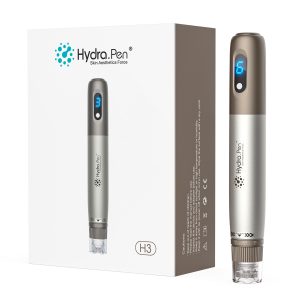
DR.pen H3-W
Original price was: $70.00.$46.00Current price is: $46.00. -
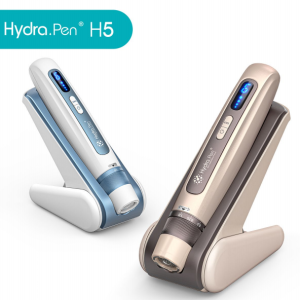
DR.pen H5W
Original price was: $100.00.$72.00Current price is: $72.00. -
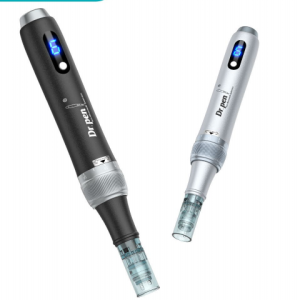
Dr.pen M7S
Original price was: $35.00.$25.00Current price is: $25.00. -
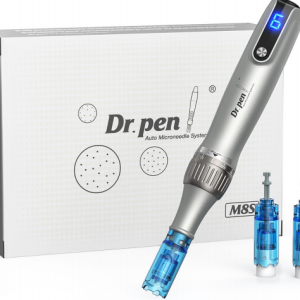
DR.pen M8S
Original price was: $55.00.$41.00Current price is: $41.00.
Needle Type and Number: Discussion generally agrees that for the face, a 36- or 24-needle cartridge is a common and suitable starting point for most people, balancing coverage and comfort. Microneedling with more needles is often better. Needles with fewer needles (such as 12 needles, 18 needles) are usually thicker and may be used for local scars or texture problems that require more precise and deeper treatment.
“Nano needles”: need to be distinguished from microneedles. It does not puncture the skin, and its main function is to promote product absorption. It can be used as a “mini care” for daily maintenance, but it cannot replace the skin rejuvenation effect of real microneedle.
Equipment comparison: Some experienced users recommend Derminator 2, believing that its motor is more stable and parameter control is more precise, but Dr. Pen M8S is more portable due to its wireless design.
- Depth and speed parameter setting guide
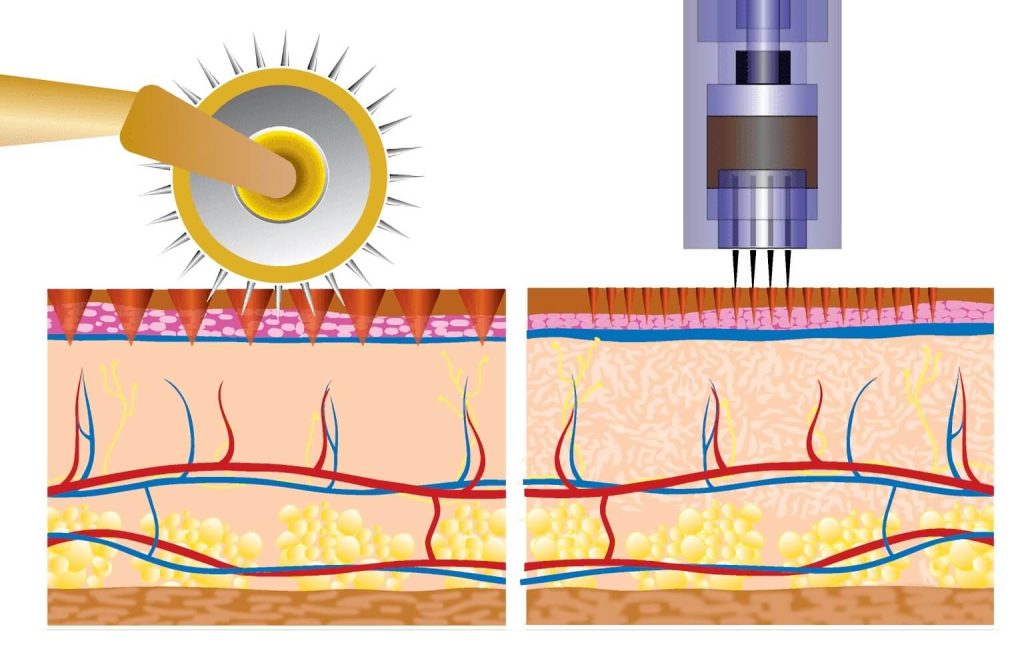
Depth principle: generally follow the “from shallow to deep” principle. It is recommended to start with a shallower depth and adjust according to skin tolerance.
Face: Usually the depth is set between 0.25mm (cosmetic grade, used for product introduction) to 0.5mm (medical grade, used to improve scars and wrinkles). You can try 0.5mm on the forehead, cheekbones and other parts, but be cautious.
Around the eyes: The skin is the thinnest, so be sure to use the shallowest depth (such as 0.25mm or less) and operate gently.
Body: For stretch marks and cellulite, a deeper depth may be required (up to 1.0mm or more, it is recommended to try after full research), but you still need to start shallow for the first try.
Speed settings: Low speed is more suitable for beginners and easier to control; high speed covers faster but may be more exciting. It is recommended to start at a low speed and then adjust according to needs after getting used to it.
- Suggestions for pairing with essence
During operation: sterile essence with simple ingredients must be used. Hyaluronic acid (HA) is the safest and most common choice, providing lubrication and helping to hydrate and repair.
For hyperpigmentation: Users have mentioned that using a PDRN (polydeoxyribonucleotide)-containing serum (such as Curenex) can help repair it. However, it is emphasized that avoid using any strong irritating active ingredients (such as high-concentration VC, acids) during operation to avoid severe irritation.
Post-operative recovery: Use a calming mask (such as a medical recovery dressing) immediately after the procedure to help reduce redness. Continue to use moisturizing and repairing products for the next few days.
- Operating techniques and techniques
Techniques: Common techniques include circular motions, horizontal/vertical linear movements, and stamping. Circular and linear movements are used for large area treatment; the point pressure method is used for local areas that require focused treatment (such as wrinkles, deep scars).
Angle: Keep the device perpendicular to the skin surface to ensure even and effective needle penetration.
Lubrication: During the operation, be sure to keep a sufficient amount of essence on the skin surface as lubrication to avoid skin damage caused by dry rubbing.
Body parts: It is more difficult to operate on uneven parts such as thighs and knees. Some users believe that the microneedle roller may be easier to operate on large areas of the body than a pen-type device.
- Important matters needing attention
Sterility First: Use new, sterile needles every time, and clean your face and equipment thoroughly before and after procedures.
Frequency cycle: Deep care (depth >0.5mm) should be performed at least 4-6 weeks apart to give the skin sufficient time to repair. Superficial introduction (about 0.25mm) can be done once a week or every two weeks, but skin reaction needs to be paid close attention to.
Preoperative anesthesia: For deeper procedures, it is recommended to use epidermal anesthetic cream to improve comfort.
Postoperative care: Strictly protect yourself from the sun, avoid using irritating skin care products, and strengthen moisturizing.
Learn first: It is strongly recommended that novices systematically watch professional tutorials (such as bloggers such as SkinwithJaymie recommended by users) to fully understand the risks and techniques before operating.
Summary: Home microneedling is an efficient but rigorous skin care method. The key to success is to start with low parameters, focus on surgical rules, focus on sterility and safety, and success or failure depends on postoperative repair. For improving pores, fine lines, superficial scars and body texture, adhering to the correct at-home microneedling regimen has proven to be effective, but for severe skin problems, it is still recommended to consult a professional doctor.
This answer is generated by AI and the content is for reference only, please review it carefully.
